
Learn the Fundamentals
Sailing Basics
The knowledge every sailor builds on: how a boat sails, the language of the water, and the skills you will use on day one of your first course.
The Language of Sailing
Parts of a Sailboat, in Plain English
Every skill on the water rests on a shared vocabulary. Learn these dozen words and the rest of sailing stops sounding like a foreign language.
- Bow and stern. The front and the back of the boat.
- Port and starboard. Left and right when you face forward. Port is left, and both words have four letters, which is how sailors remember it.
- Hull and keel. The body of the boat and the fin beneath it that keeps you upright and stops the boat sliding sideways.
- Mast and boom. The vertical spar that holds the sails up, and the horizontal one that swings across the deck.
- Mainsail and jib. The large sail behind the mast, and the smaller one in front of it.
- Halyard and sheet. A halyard raises a sail. A sheet controls its angle to the wind. Pulling a sheet in is called trimming.
- Helm. The wheel or tiller you steer with.
The Core Concept
Points of Sail: How a Boat Moves Around the Wind
A sailboat cannot sail straight into the wind, but it can sail almost anywhere else. The points of sail describe your direction relative to where the wind is coming from, and every maneuver is really just moving between them.
- Into the wind, the no go zone. Point straight at the wind and the sails flap uselessly. Sailors call this being in irons.
- Close hauled. Sailing as close to the wind as the boat will allow, roughly 45 degrees off it. This is where the boat heels over and feels most alive.
- Reaching. The wind is on your side. A beam reach, with the wind at 90 degrees, is the fastest and easiest point of sail for most boats.
- Running. Sailing with the wind behind you, sails let all the way out.
Tacking is turning the bow through the wind to change direction, and jibing is turning the stern through it. To reach a destination that sits upwind, you tack back and forth in a zigzag, a technique called beating. This one idea, sailing at an angle to travel toward the wind, is the thing that surprises every new sailor.
Why It Works
How a Sail Moves a Boat Against the Wind
A sail is a wing turned on its side. As wind flows across its curved surface it generates lift, the same force that holds up an airplane, except here it pulls the boat forward instead of up. The keel underneath resists the sideways part of that force, so the boat converts most of the push into forward motion. That is why you can sail toward the wind at an angle, something that feels like it should be impossible until you have done it yourself.
Rope You Can Trust
The Only Knots You Really Need
- Figure eight. A stopper knot that keeps a line from slipping through a block.
- Cleat hitch. How you secure a line to a cleat on the dock or deck.
- Bowline. A fixed loop that will not slip and unties easily even after load. The most useful knot on any boat.
- Round turn and two half hitches. A reliable way to tie a line to a ring or a rail.
Four knots cover the vast majority of what you do on deck. You will have them memorized by the end of your first day sailing.
Sharing the Water
Right of Way, the Basics
A few simple rules keep everyone safe, and they are worth knowing before your first sail:
- When two sailboats meet, the one with the wind on its starboard side has right of way.
- When both have the wind on the same side, the boat further upwind keeps clear.
- A boat overtaking another always keeps clear of the boat ahead.
- In most situations powered vessels give way to sailing vessels, though you never assume it and always keep a watch.
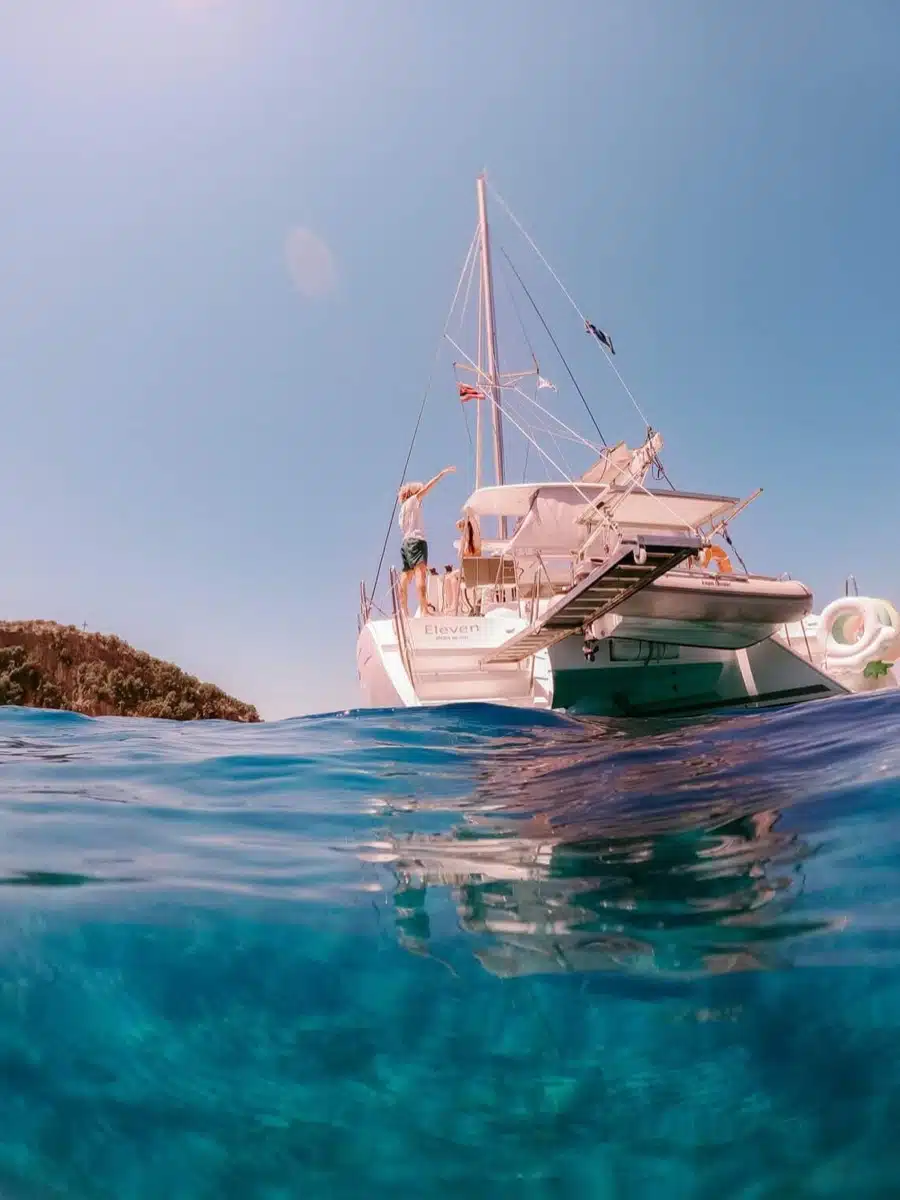
Faster Than Reading
Learn It on the Water
Everything on this page is covered hands on in the first days of our Intro to Sailing course. Three days, zero experience required, and you leave with an IYT International Crew certification.
The Path
Where the Basics Take You
Intro to Sailing
IYT International Crew – 3 daysZero experience required. Learn the fundamentals as working crew on a real yacht.
Day Skipper
IYT Day Skipper – 4 daysTake the helm. Skipper a yacht on day passages with confidence.
Become the Captain
IYT Bareboat Skipper + ICC + VHF – 7 daysCharter yachts up to 60 feet anywhere in the world. No instructor required.
Answers
Frequently Asked Questions
Is sailing hard to learn?
No. The fundamentals are simple enough to grasp in a weekend, and most of learning to sail is repetition and feel rather than memorization. What looks complicated from the dock becomes intuitive within a few hours on the water.
What should a beginner learn first?
Start with the points of sail and the parts of the boat, then add steering and a few core knots. Everything else builds on those. On a course you learn them in the order you actually need them.
What is the difference between tacking and jibing?
Both turn the boat to change direction. Tacking turns the bow through the wind, and jibing turns the stern through it. Tacking is gentler, and jibing needs more care because the boom swings across the deck.
Can you sail directly into the wind?
No. A sailboat cannot make progress straight into the wind. Instead you sail at an angle to it and zigzag toward your destination, a technique called beating to windward.
How many knots do I actually need to know?
About four: the figure eight, the cleat hitch, the bowline, and the round turn with two half hitches. Those cover nearly everything you do on deck.
Keep Exploring
Skip Ahead: Learn by Sailing
The fastest way through the basics is three days on a yacht with an instructor. Beginners welcome.